
Leominster Resident Lookup Record Coverage
A useful resident lookup starts with the narrowest official record that can answer the question. The City assessor and GIS card identify a parcel and its owner of record. The Worcester Registry identifies a recorded party to an instrument. A court docket identifies a party and case information when public. The City Clerk, Massachusetts Registry of Vital Records and Statistics, or State Archives handle different event periods. Library directories and newspapers place people in a dated historical setting. No single one of these sources proves current occupancy, relationship, or identity across all years.
| Record | What it confirms | Where | Access |
|---|---|---|---|
| Massachusetts voter status | Individual registration or pre-registration, status, polling place, and officials | Secretary of the Commonwealth form | Name, date of birth, and residential ZIP are required. |
| Assessor and GIS | Parcel, owner of record, situs, and assessment context | Leominster municipal system | Owner is not automatically an occupant; mailing address can differ. |
| Registry deed index | Recorded party, role, instrument, date, book/page, and transfer | Worcester Registry of Deeds | 1731 to present; older work uses index books. |
| Court docket | Party, case number, filing, event, or disposition when public | MassCourts and the clerk | Match court, location, case type, and date. |
| Vital record | A birth, marriage, or death event | City Clerk, RVRS, or State Archives | Age, requester, and record-specific access rules apply. |
| Library directory or newspaper | Historical name, address, obituary, or local context | Leominster Library and archive sources | Year-specific evidence, not current proof. |
Start with a supplied fact, not a broad name sweep. A person with a common name needs at least two independent date markers. In Leominster, an assessed owner, a deed party, a registered voter, and a directory resident are four distinct relationships to an address. They may all be accurate at the same time while describing different moments or roles.
Leominster Resident Lookup Through Voter Status
Massachusetts provides an individual check through My Voter Registration Status, not an unrestricted statewide name or street browser. Under M.G.L. c. 51 §64, the search uses a name, date of birth, and residential ZIP code. Its result can report registration or pre-registration status, active or inactive status, polling place, and state or federal officials. It is appropriate for confirming a supplied person and ZIP combination, not for looking through nearby names.
| Name | Required text entry for the individual status check. |
|---|---|
| Date of birth | Required identifier under M.G.L. c. 51 §64. |
| Residential ZIP code | Required five-digit residential ZIP. |
| Result | Registration/pre-registration, active/inactive status, polling place, and officials. |
The Secretary’s voter-information access page describes the fields available in a public voter file and the fields excluded from it. Phone numbers, email, veteran status, permanent-absentee status, confidential voter records, and minors’ records are excluded. A municipal request should be limited to an existing local list, year, precinct, street range, or other clear scope. Leominster has no verified public online browse-by-street voter list.
Note: Registration status is dated evidence, so it should not be treated as proof of continuous residence.
Verifying a Leominster Resident Record
To look up a resident responsibly, keep the original spelling, every date, and the source URL beside each result. That record of the search keeps a partial match from becoming a mistaken identity. An address can anchor a parcel search, but first determine whether it is a situs address, an owner mailing address, or an address stated in an older record. A Leominster parcel may have a tax-bill contact outside the city, and a Leominster mailing address does not establish occupancy.
- Normalize the supplied name, middle initial, possible age or year, street, ZIP, and known relationship. Keep alternate spellings rather than silently selecting one.
- Use the voter-status form only when the required name, date of birth, and residential ZIP are already known. Save the search date and displayed status.
- Search the Leominster GIS by address or parcel ID, then compare the parcel ID, exact owner spelling, situs, valuation year, and mailing field.
- Search the Worcester Land Records portal by a verified name, town, and date range. Capture the party role, instrument, recorded date, and book/page before relying on a transfer.
- Use MassCourts only for a supplied case clue, and compare court location, case type, filing date, docket, and party role. Ask the proper custodian about certified records.
- Docket
- The court’s official case identifier and event record. It is the most useful key for finding the same case again or asking a clerk about a copy.
- Index versus image
- An index is a finding aid that lists record details. An image is the underlying document or page, which may have different availability rules.
- Certified copy
- A copy issued or authenticated by the record custodian for an official purpose. An online result is not automatically a certified copy.
MassCourts in a Leominster Resident Lookup
The public MassCourts search begins with an “I’m not a robot” check and a public-records choice. Court Department is required before the division and, in some instances, location fields populate. Name, Case Type, Case Number, and Ticket/Citation Number are separate search tabs. Choose Leominster District Court when that location is relevant. The court at 25 School Street serves Leominster, Holden, and Princeton. Probate questions may belong at Worcester Probate and Family Court instead.
A MassCourts public-search view shows the state portal used to choose a department, location, and search method.
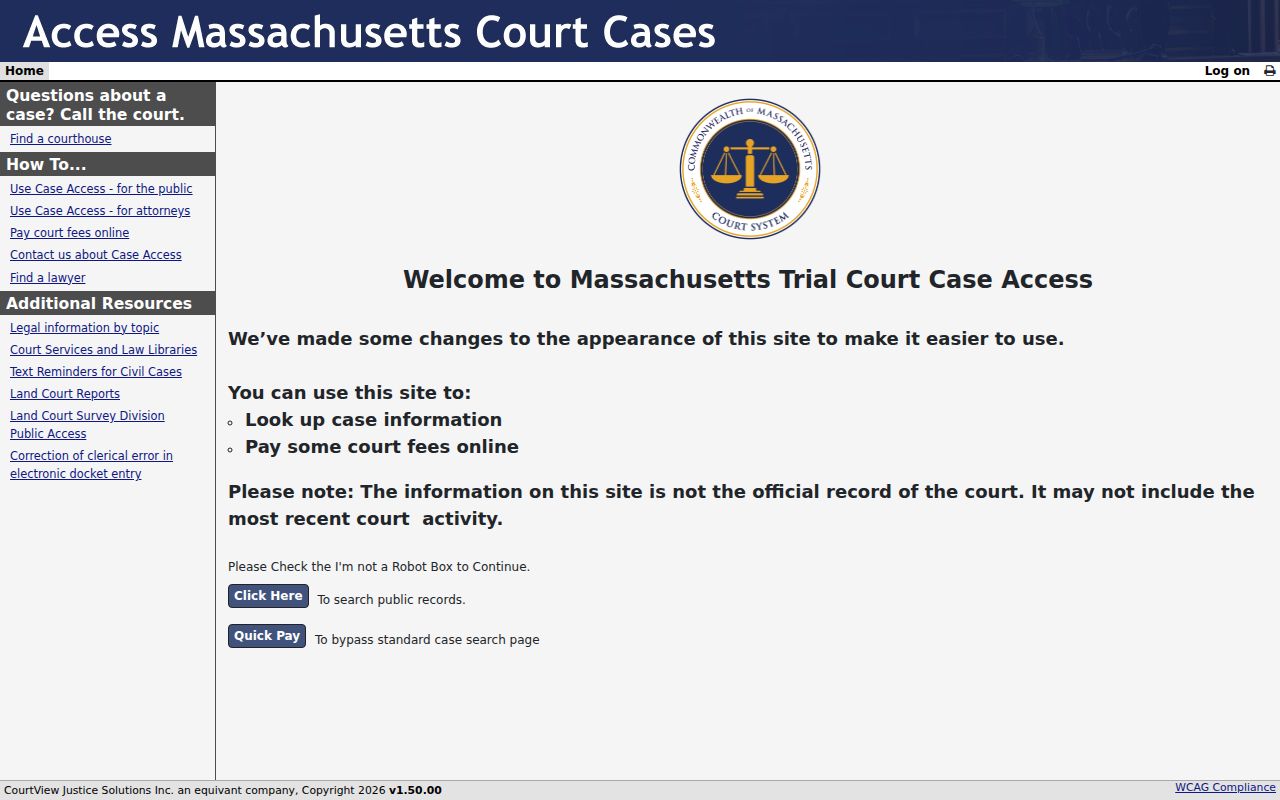
Pick the court layer before relying on a name hit. A public web result does not guarantee that every related document is viewable remotely. Courthouse public terminals and the clerk remain the authoritative fallback for an incomplete web result, a restricted-file question, or a certified copy.
| Court Department | Required selection that controls later court choices. |
|---|---|
| Court Division and Location | Conditional selections; use the proper Leominster or Worcester venue. |
| Name search | Last name is required; the guide advises at least two characters for civil searches. First name can narrow a common surname. |
| Case Type dates | The portal guide limits a case-type query to a 30-day window. |
| Case number | Exact formatting, capitalization, spacing, and leading zeroes matter. |
The official MassCourts docket-search guide explains these fields and exact-format limits.
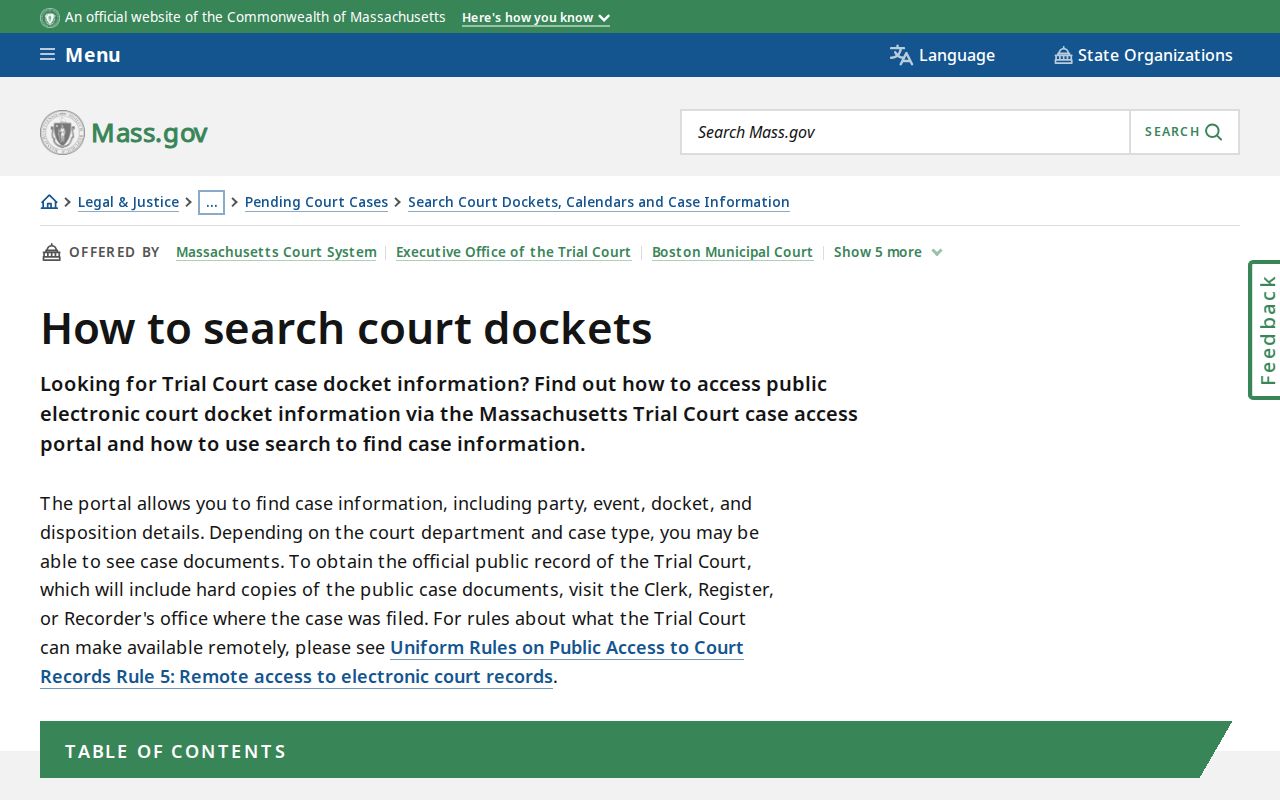
A result may show party name and role, docket, court, case type, filing date, events, and a disposition when public. Sealed, impounded, juvenile, expunged, and restricted material may be absent or redacted.
Leominster Resident Lookup Vital Evidence
Vital records confirm events, not a person’s current address. The Leominster City Clerk handles local births, deaths, marriage intentions, and certificates. Massachusetts Registry of Vital Records and Statistics handles state-held records identified as 1936 to present, while the Massachusetts State Archives holds 1841 to 1935 material. For a marriage, the place where the intention was filed can matter more than where a ceremony occurred. Check the record’s date and local policy before requesting it.
Leominster lists a $10 fee for a certified birth, marriage, or death copy. It says death certificates are public, while birth and marriage access can depend on age, requester, and circumstances. The city’s July 1, 2026 notice says social security numbers are no longer placed on death certificates under the updated M.G.L. c. 46 §1 treatment, with a full number requiring a legitimate reason. Older-record access is governed in part by M.G.L. c. 46 §2A and should not be reduced to a single automatic rule.
The Massachusetts vital-record ordering page shows the state route for event certificates.
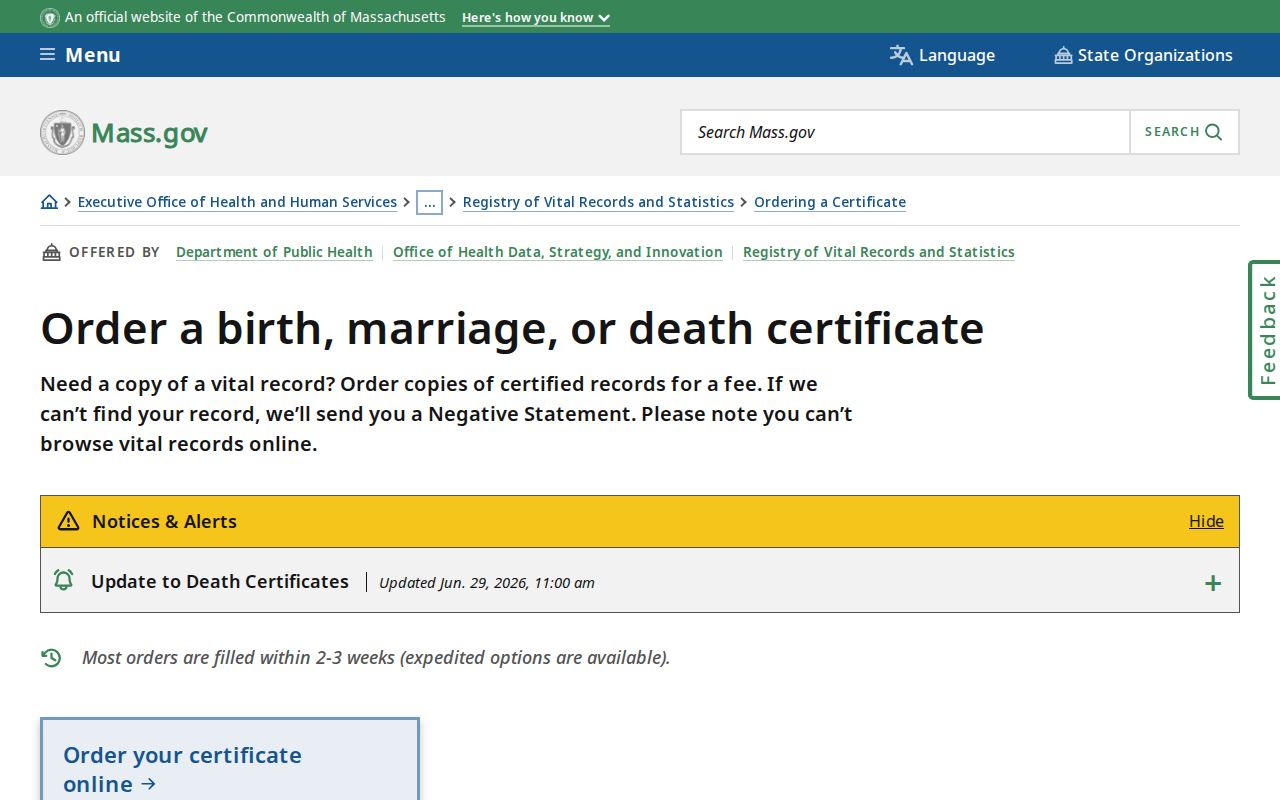
Most state orders take roughly two to three weeks according to the order page. Supply the name, event date and place, then let the appropriate custodian decide whether a copy is available. The Leominster City Clerk accepts eligible local death-certificate requests in person, online, and by mail, while other vital requests follow their specific local and state rules.
Leominster Resident Lookup Historical Corroboration
For family history or reconnection, a historical entry needs a second dated source. The Leominster Library holds directories from 1900 to 1990, most telephone directories from 1981 forward, newspapers, clippings, yearbooks, church histories, annual reports, and microforms. Its limited obituary research service asks for the person’s name, death month and year, and last city or town of residence. It can produce an estimate or status within 48 hours. That is a sound way to expand an abbreviated old listing without treating the listing as a current record.
The 1915 Price & Lee directory uses marks such as h for a residence clue, N L for North Leominster, and do for the same as above. Read the abbreviation key and compare adjacent directory years. A city directory entry should remain tied to its publication year. The Leominster city directories collection explains the available historical shelves, Street Guide, newspaper runs, and 1915 scan in more detail.
Business certificates, corporation filings, professional licenses, and cemetery cards can corroborate a dated role or event, but none is a residence record. A city business certificate can identify a DBA and business location; it does not identify every person connected to that place. Similarly, a burial card is evidence of burial or lot information, not a current address.
Note: When sources conflict, sort them by date and role before deciding that any record is wrong.
Leominster Resident Lookup Request Route
When a needed record has no public search form, request the existing record from the office that holds it. Leominster’s public-information request form asks for the requester’s name and contact information, a full description, and a date or date range. The city says it will contact the requester about estimated cost, requires payment before processing where applicable, and allows up to 10 business days. A request for a defined permit card, street list, or other record class is more workable than a request for an agency to identify an unknown person.
Massachusetts guidance permits electronic, mailed, and in-person public-record requests under M.G.L. c. 66, while vital records, election files, court records, and police material may have specialized custodians or separate restrictions. Ask for the non-exempt portion if redaction is needed, preserve a copy of the request, and use the specific city, county, or state channel that matches the record. That keeps a Leominster resident lookup tied to a verifiable source and gives the custodian the information needed to search.
Leominster Resident Lookup Privacy Limits
Public access has boundaries. The Massachusetts Address Confidentiality Program provides a substitute address and mail forwarding for eligible participants, including survivors of domestic violence, sexual assault, and stalking. Supreme Judicial Court Rule 1:20 permits a qualifying participant to use that substitute address in public civil proceedings while the actual-address affidavit is impounded. Do not attempt to infer, uncover, or publish an ACP participant’s location.
Custodians also apply distinct rules to confidential voters, minors’ data, restricted court material, and record-specific vital information. Massachusetts Public Records Law, M.G.L. c. 66 and M.G.L. c. 4 §7 cl. 26, concerns existing public records. It does not require an office to build a resident list, solve an incomplete identity, or release exempt material. If an official record is inaccurate, ask the exact custodian about its correction or confidentiality process.
Lawful use. Keep a Leominster resident lookup narrow and tied to a lawful personal, civic, or historical purpose. Never use a record trail to stalk, harass, intimidate, or expose a protected person.